[data-reveal]{opacity:1!important;transform:none!important}
2026One ecosystem · three products · zero lock-in.

Better than a stack of tools,an ecosystem that fits together.

Start with a framework that extends hexagonal architecture to the modules you install. Follow DMS and Cloud as they develop — an ecosystem built around explicit contracts and clear responsibilities.

FrameworkCore Open source
DMSDashboard In development
CloudManaged In development
  • Free forever
  • Apache 2.0 licensed
  • Node.js · TypeScript

The ecosystem

A modular stack for modern teams.

AntelopeJS brings together an open-source Framework, an extensible Dashboard Management System and a Cloud platform in development — three products shaped by the same modular ambition.

Framework · modular runtimeDMS · admin system in developmentCloud · control plane in development

Meet the three products

Each has a clear role — and its own release timeline.

Open source

01 — open source AntelopeJS Framework

Hexagonal architecture, beyond your own code. Keep business logic behind explicit contracts and bring ecosystem providers into the same model. Built for Node.js and TypeScript.

See the framework Apache 2.0
In development

02 — in development AntelopeJS DMS

An extensible admin foundation for pages, data-heavy components, multi-tenancy and role-based permissions.

In development
In development

03 — in development AntelopeJS Cloud

A cloud control plane in development for projects, environments, services, deployments and infrastructure operations.

In development

The products

Built to stand on its own.

Each product has a clear scope and its own release timeline. Start with the one that solves today’s problem, then evaluate the others as they mature.

01 · Framework

Hexagonal architecture. Beyond your own code.

Keep your business logic behind explicit contracts. Bring your own adapters and ecosystem modules into the same architecture, with implementations selected at the application boundary.

  • Depend on the contract, not the provider. Consumers call a capability through its interface. The provider module owns the integration.
  • Choose implementations at the boundary. The application selects the adapter. A replacement must respect the same contract and behavior; configuration and migrations remain yours to handle.
  • Keep the architecture. Skip the plumbing. Antelope provides interface binding, module lifecycle and application assembly for your modules and ecosystem packages alike.
Interface → consumer → provider
TypeScript
1// @org/interface-email
2export const SendEmail = InterfaceFunction<
3  (message: EmailMessage) => Promise<void>
4>();
5 
6// modules/billing
7await SendEmail({ to, subject, body });
8 
9// modules/email-smtp
10export async function construct() {
11  ImplementInterface(
12    await import("@org/interface-email"),
13    await import("./smtp"),
14  );
15}
02 · DMS · In development

Your product, under control.

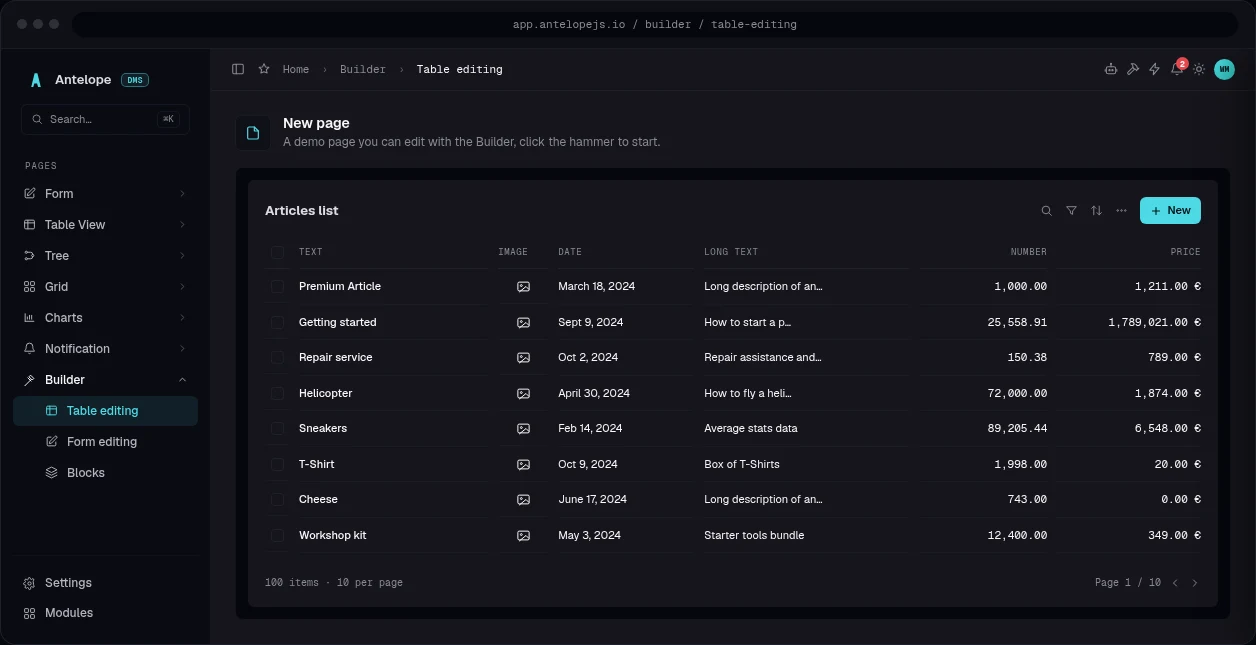
DMS gives your product a modular administration foundation — pages, admins, roles, permissions and theming — that you can extend as your operational needs grow.

  • Don't rebuild the admin core. Start from the foundations every product needs to manage users, access and internal workflows.
  • Adapt it to your product. Build focused admin experiences in TypeScript while upcoming visual tooling makes common pages faster to compose.
  • Add capabilities as you grow. Extend the same administration surface through optional modules instead of accumulating disconnected tools.
AntelopeJS DMS table editing interface
03 · Cloud · In development

From application to infrastructure, without the maze.

AntelopeJS Cloud is being built to turn application requirements into clear deployment plans, giving teams one place to manage services, environments and releases.

  • From project to deployment, simply. Connect a project, review what it needs and manage environments and releases in one flow instead of stitching tools together.
  • Your maximum bill, before deploy. Resource bounds translate into a visible spending ceiling, with actual usage tracked against it.
  • Native to AntelopeJS. The framework's application model carries requirements forward, while regular container workloads still fit.
cloud / atlas / productionPreview
Deployment plan

atlas-production

Not applied
Application2 container services
Environmentproduction
Planned resources2 services
apiContainer workload
Planned
workerContainer workload
Planned
No infrastructure changes have been applied.

Why AntelopeJS

A modular foundation that keeps your choices open.

Build on an open-source framework today, add the products you need as they mature, and keep adoption on your terms.

One architecture, across the ecosystem

Bring your own modules and ecosystem providers into the same contract model, instead of maintaining a separate integration architecture.

Change the adapter, not the consumer

Keep business code behind explicit contracts. Select compatible providers at the application boundary and verify their behavior against those contracts.

Own your foundation

The Framework is Apache 2.0 licensed and self-hosted. Your application does not depend on a proprietary runtime.

Adopt at your own pace

Framework, DMS and Cloud each have a clear scope and release timeline. Start with the part that solves a problem now.

Open source & community

Follow the work. Help shape what comes next.

The Framework is open source today, while DMS and Cloud are still in development. Explore the code, follow upcoming releases and share feedback with the team on GitHub or Discord.